mirror of
https://github.com/microsoft/regorus.git
synced 2026-08-05 02:16:11 +00:00
 Anand Krishnamoorthi
2a0b4ae6b5
Anand Krishnamoorthi
2a0b4ae6b5
This change integrates mimalloc as the default memory allocator for Regorus,
delivering significant performance improvements across all evaluation modes
and language bindings.

Technical Implementation:
- Build mimalloc in vendored mode from C sources (following QSharp approach)
- Implement GlobalAlloc trait for seamless Rust integration
- Add optional 'mimalloc' feature flag for conditional compilation
- Add comprehensive ACI benchmarks to measure evaluation performance

Performance Impact:

Rust Engine Evaluation:
- Single-threaded: ~29% improvement (423 vs 328 Kelem/s)
- Multi-threaded: Better scaling with reduced thread contention
- Fresh engines: ~24% improvement (56 vs 45 Kelem/s)

Rust Compiled Policy Evaluation:
- Single-threaded: ~41% improvement (426 vs 303 Kelem/s)
- Multi-threaded: Improved allocation efficiency under contention
- Fresh compilation: ~26% improvement (53 vs 42 Kelem/s)

C# FFI Bindings:
- Engine evaluation: ~27% improvement (279 vs 219 Kelem/s)
- Compiled policies: ~29% improvement (273 vs 211 Kelem/s)
- Better threading characteristics through improved underlying allocation

Key Benefits:
- Reduced allocation-related contention in multi-threaded scenarios
- More consistent performance across different thread counts
- Improved memory allocation efficiency for both native Rust and FFI workloads
- Better scaling characteristics for production deployments

The mimalloc integration provides substantial performance gains while
maintaining full compatibility with existing code through feature flags.

Reference: QSharp allocator implementation
(https://github.com/microsoft/qsharp/tree/main/source/allocator)

Fixes #297

Signed-off-by: Anand Krishnamoorthi <anakrish@microsoft.com>
Regorus CSharp
Regorus is
- Rego-Rus(t) - A fast, light-weight Rego interpreter written in Rust.
- Rigorous - A rigorous enforcer of well-defined Rego semantics.
See main Regorus page for more details about the project.
Building
Github Actions
The simplest way to build a Nuget for Regorus' C# bindings is to use Github Actions. The action to do so is named bindings/csharp and is defined in .github/workflows/test-csharp.yml.
There are two ways to trigger a Nuget build.
- Runs are triggered automatically whenever a push or pull request is made to the
mainbranch. - A run can be triggered manually by navigating to the action in the Github UI and clicking
Run workflow. This option allows you to generate a Nuget for any branch, which is useful when testing the integration of in-progress changes to Regorus with other projects. Nuget files that are generated via this flow will have amanualtriggersuffix appended to their version number, making it easy to distinguish them from Nugets generated using themainbranch.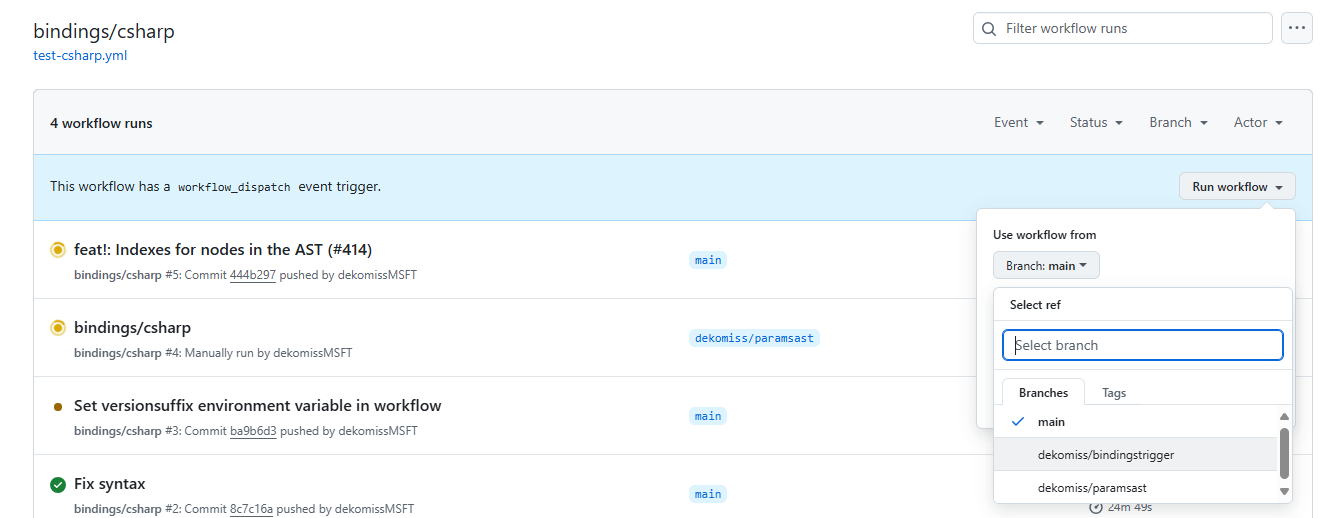

Once the workflow run completes, the generated Nuget can be downloaded by following these steps:
- Open the run.
- Click on
Build Regorus nugeton the left. - Expand the
Upload Regorus nugetstep. - Click the
Artifact download URLlink at the bottom. - Save and extract the downloaded zip file to find the
.nupkgfile.

Local
TODO