mirror of
https://github.com/microsoft/regorus.git
synced 2026-08-05 02:16:11 +00:00
 fd59bb5a91
Policy evaluation at scale needs to be able to set memory limits
so that a bad policy does not hog memory or to ensure that
policy evaluation itself does not use too much memory which could
cause other components to suffer.

This PR introduces capability to set and enforce global memory limits.
It also lays the groundwork for enabling per evaluation limits in future.

Once a global memory limit is set, Regorus maintains per thread counters
to track memory activity (allocation, deallocation) of a thread.
These counters are periodically flushed to global memory counters.
Per thread counters avoid the contention that updating global counters
on each alloc/free would cause.

Policy evaluation periodically checks these counters and raises errors
if allocated memory has exceeded the configured limit.

Currently memory limit capability is exposed only to FFI and C#.

Also update mimalloc to v2.2.6

Signed-off-by: Anand Krishnamoorthi <anakrish@microsoft.com>
2.7 KiB
2.7 KiB
Regorus CSharp
Regorus is
- Rego-Rus(t) - A fast, light-weight Rego interpreter written in Rust.
- Rigorous - A rigorous enforcer of well-defined Rego semantics.
See main Regorus page for more details about the project.
Building
Github Actions
The simplest way to build a Nuget for Regorus' C# bindings is to use Github Actions. The action to do so is named bindings/csharp and is defined in .github/workflows/test-csharp.yml.
There are two ways to trigger a Nuget build.
- Runs are triggered automatically whenever a push or pull request is made to the
mainbranch. - A run can be triggered manually by navigating to the action in the Github UI and clicking
Run workflow. This option allows you to generate a Nuget for any branch, which is useful when testing the integration of in-progress changes to Regorus with other projects. Nuget files that are generated via this flow will have amanualtriggersuffix appended to their version number, making it easy to distinguish them from Nugets generated using themainbranch.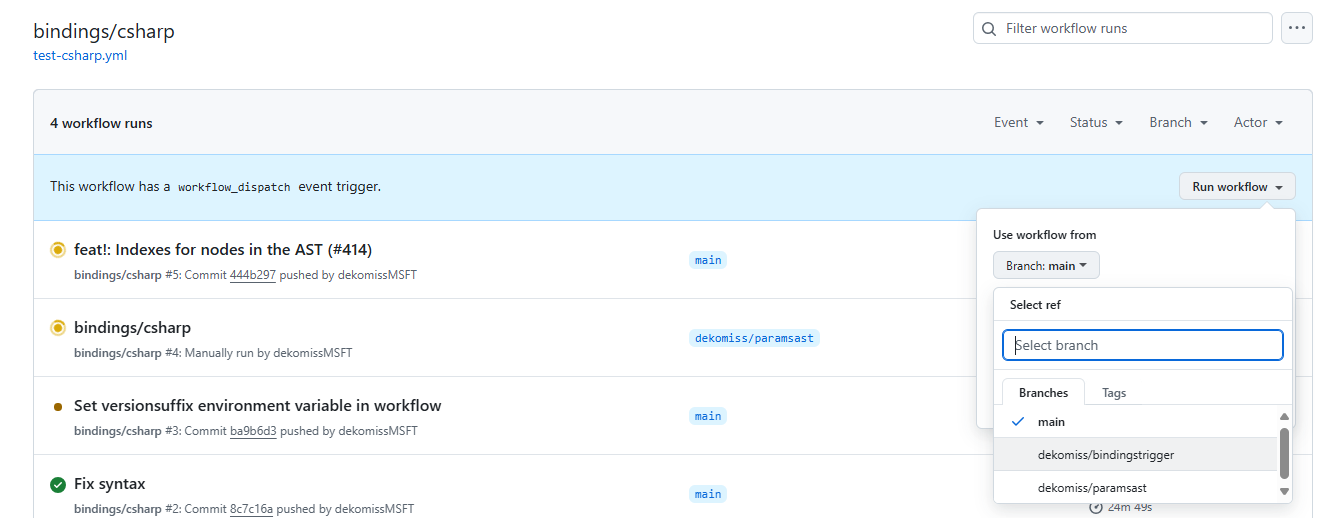

Once the workflow run completes, the generated Nuget can be downloaded by following these steps:
- Open the run.
- Click on
Build Regorus nugeton the left. - Expand the
Upload Regorus nugetstep. - Click the
Artifact download URLlink at the bottom. - Save and extract the downloaded zip file to find the
.nupkgfile.

Local
TODO
Memory Usage Safeguards
The C# bindings expose allocator-backed memory tracking utilities via the static Regorus.MemoryLimits helper. Typical usage:
// Restrict total allocations to 128 MiB for the process
Regorus.MemoryLimits.SetGlobalMemoryLimit(128 * 1024 * 1024);

// Optional: tune how frequently each thread flushes its allocation counters
Regorus.MemoryLimits.SetThreadFlushThresholdOverride(256 * 1024);

// Engine operations throw InvalidOperationException with the allocator message if the budget is exceeded
using var engine = new Regorus.Engine();
var veryLargeJson = new string('x', 128 * 1024);
try
{
  engine.SetInputJson(veryLargeJson);
}
catch (InvalidOperationException ex)
{
  Console.WriteLine($"Allocator reported: {ex.Message}");
}

// Restore defaults once done
Regorus.MemoryLimits.SetGlobalMemoryLimit(null);
Regorus.MemoryLimits.SetThreadFlushThresholdOverride(null);
See bindings/csharp/Regorus.Tests/RegorusTests.cs for scenario coverage and bindings/csharp/TargetExampleApp/Program.cs for end-to-end usage.