mirror of
https://github.com/microsoft/regorus.git
synced 2026-08-05 02:16:11 +00:00
 Anand Krishnamoorthi
6dc505c88b
Anand Krishnamoorthi
6dc505c88b
* build: Add xtask automation for binding version management

Introduces a dedicated xtask crate that keeps language binding versions
in sync with the core regorus crate, following the workflow pattern used
by rust-analyzer, gitoxide, and ripgrep.

Key features:
- Git-based change detection: compares binding source files against a
  base ref (merge-base with origin/main by default) plus unstaged/
  untracked files to identify which bindings have been modified
- SemVer-aware bumping: binding edits trigger a minor version increment
  (e.g. 0.5.1 → 0.6.0) under pre-1.0 semantics, signaling potential
  breaking changes; clean bindings simply align to the root version
- Multi-language support: updates Cargo manifests (Rust FFI, Java,
  Python, WASM, Ruby), Maven pom.xml (Java), Ruby version constants,
  and C# project files in a single pass
- CI integration: --check mode fails fast when manifests are out of
  sync, ensuring pre-commit and release-plz workflows catch stale
  versions before merge

Integration points:
- release-plz.toml: runs cargo xtask bindings --base-ref origin/main
  after bumping the root crate, so binding versions are updated
  atomically during the release process
- scripts/pre-commit: invokes cargo xtask bindings --check to block
  commits that would leave bindings out of sync
- .cargo/config.toml: defines cargo xtask alias for convenience

Documentation includes inline examples showing how version bumps behave
when bindings are ahead/behind the root, and notes that the minor
field acts as the major version under SemVer 0.y.z initial development
phase.

Signed-off-by: Anand Krishnamoorthi <anakrish@microsoft.com>

* build: refresh xtask tooling, workflows, and locks

- cargo xtask bindings: keep the binding version-sync pipeline intact
- cargo xtask update-deps: new helper to regenerate workspace/binding Cargo.lock files
- workflows: auto-detect the Java jar version in CI and temporarily disable the Ruby workflow
- lock files: refresh root + binding snapshots after the dependency sweep

Signed-off-by: Anand Krishnamoorthi <anakrish@microsoft.com>

---------

Signed-off-by: Anand Krishnamoorthi <anakrish@microsoft.com>
Regorus CSharp
Regorus is
- Rego-Rus(t) - A fast, light-weight Rego interpreter written in Rust.
- Rigorous - A rigorous enforcer of well-defined Rego semantics.
See main Regorus page for more details about the project.
Building
Github Actions
The simplest way to build a Nuget for Regorus' C# bindings is to use Github Actions. The action to do so is named bindings/csharp and is defined in .github/workflows/test-csharp.yml.
There are two ways to trigger a Nuget build.
- Runs are triggered automatically whenever a push or pull request is made to the
mainbranch. - A run can be triggered manually by navigating to the action in the Github UI and clicking
Run workflow. This option allows you to generate a Nuget for any branch, which is useful when testing the integration of in-progress changes to Regorus with other projects. Nuget files that are generated via this flow will have amanualtriggersuffix appended to their version number, making it easy to distinguish them from Nugets generated using themainbranch.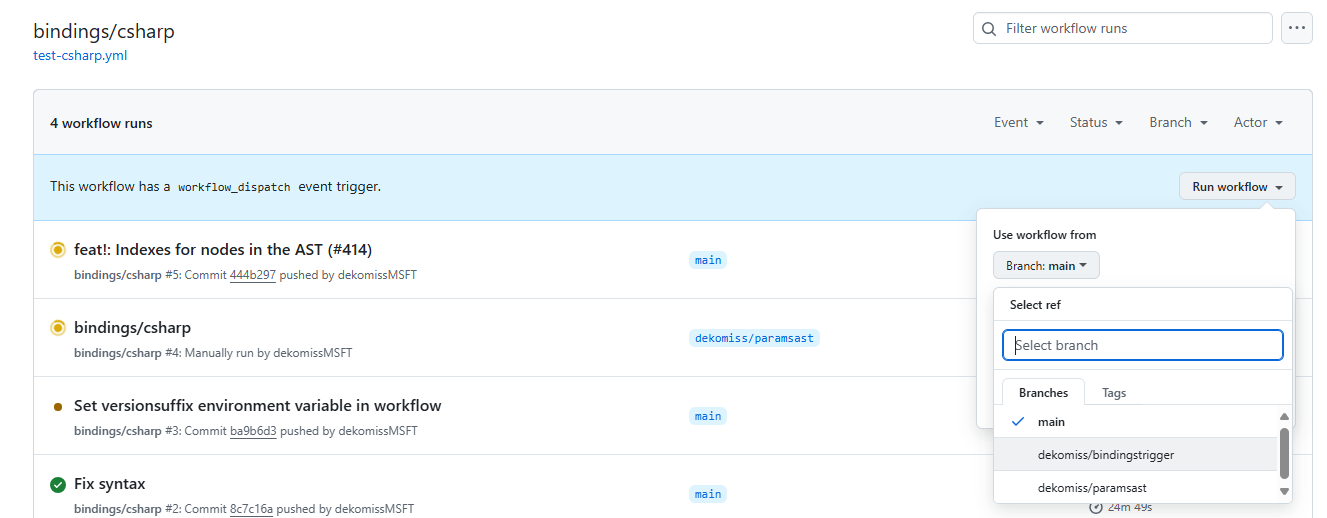

Once the workflow run completes, the generated Nuget can be downloaded by following these steps:
- Open the run.
- Click on
Build Regorus nugeton the left. - Expand the
Upload Regorus nugetstep. - Click the
Artifact download URLlink at the bottom. - Save and extract the downloaded zip file to find the
.nupkgfile.

Local
TODO