 Anand Krishnamoorthi
83891d7782
Anand Krishnamoorthi
83891d7782
* perf!: add LRU caches for compiled regex and glob patterns

Add bounded LRU caches for compiled regex and glob patterns used by
Rego builtins, avoiding repeated recompilation of the same patterns
during policy evaluation.

New `cache` feature (included in `full-opa` and `opa-no-std`) backed by
the `lru` crate (no_std compatible) with `spin::Mutex` for thread safety.

- `src/cache.rs`: generic `LruCache<V>` wrapper, global `REGEX_CACHE`
  (default capacity 256) and `GLOB_CACHE` (default capacity 128)
- `src/builtins/regex.rs`: all regex builtins route through the cache
- `src/builtins/glob.rs`: glob.match routes through the cache
- Public API: `regorus::cache::{Config, configure, clear}`

Compilation costs avoided per cache hit:
  regex  10-55 µs  (simple to complex patterns)
  glob   10-12 µs
  LRU hit   ~10 ns

BREAKING CHANGE: new `cache` Cargo feature added to `full-opa` and
`opa-no-std` feature sets; adds `lru` as a dependency.

Signed-off-by: Anand Krishnamoorthi <anakrish@microsoft.com>

* perf(vm): amortize per-instruction memory and time limit checks

Deduplicate per-instruction memory_check calls by hoisting them to the
main dispatch loop, and amortize monotonic_now() syscalls in the
execution timer by checking elapsed time every N instructions instead
of on every tick.

Signed-off-by: Anand Krishnamoorthi <anakrish@microsoft.com>

* fix(vm): correct object membership to check values only, not keys

The Contains instruction for objects was checking both keys and values:

    object_fields.contains_key(v) || object_fields.values().any(|v| ...)

Per the Rego specification, `x in obj` tests whether x is a VALUE of
the object, not a key. The two-argument form `k, v in obj` is needed
to access keys. The interpreter already implemented this correctly
(values-only scan), but the RVM had the extra contains_key() check
which would incorrectly return true when the search value happened to
match a key name.

Remove the contains_key() branch so the behavior matches the interpreter
and the Rego spec. Add two regression tests:
- object_membership_checks_values_not_keys: "foo" in {"foo": "bar"}
  must be false (key, not a value)
- object_membership_finds_value: "bar" in {"foo": "bar"} must be true

Signed-off-by: Anand Krishnamoorthi <anakrish@microsoft.com>

* perf(compiler): hoist all-constant collection literals to the literal table

When an array, set, or object literal consists entirely of compile-time
constant expressions (numbers, strings, bools, null, and nested constant
collections), the compiler now evaluates them at compile time and emits a
single Load instruction from the literal table instead of generating
per-element instructions at runtime.

Previously, a Rego expression like `x in [1, 2, 3]` would emit
ArrayCreate + three Load + three ArrayAppend instructions, allocating a
new Vec and Rc on every evaluation. With this change, the entire array
is built once during compilation and loaded as a single constant.

This optimization applies to all three collection types:
- Array literals: avoids ArrayCreate + N x (Load + ArrayAppend)
- Set literals: avoids SetCreate + N x (Load + SetAdd)
- Object literals: avoids ObjectCreate + N x (Load + Load + ObjectInsert)

The implementation adds a try_eval_const() helper that recursively
evaluates an AST expression as a constant Value, returning None if any
sub-expression is non-constant. Each compile method for collection
literals attempts the all-constant fast path first and falls through to
the existing instruction-by-instruction codegen otherwise.

Signed-off-by: Anand Krishnamoorthi <anakrish@microsoft.com>

* perf(compiler): fuse Eq + AssertCondition into AssertEq instruction

Add a new `AssertEq { left, right }` instruction that combines equality
comparison and condition assertion into a single operation. This replaces
the previous two-instruction pattern of `Eq { dest, left, right }` followed
by `AssertCondition { condition: dest }`, saving one instruction and one
register per equality assertion.

The fused instruction checks two registers for equality and directly calls
handle_condition with the result, avoiding the intermediate boolean
register entirely. If either operand is undefined or the values differ,
the condition fails and the rule/loop backtracks.

The optimization applies to four destructuring sites:
- EqualityCheck (assignment re-binding with `x = expr; x = expr`)
- EqualityExpr (destructuring against an expression)
- EqualityValue (destructuring against a literal value)
- assert_array_length (array length validation in destructuring)

In soft_assert_mode the compiler still emits the original Eq instruction
since the boolean result register is needed by callers.

Signed-off-by: Anand Krishnamoorthi <anakrish@microsoft.com>

* perf(compiler): fuse Not + AssertCondition into AssertNot instruction

Add a new `AssertNot { operand }` instruction that combines logical
negation and condition assertion into a single operation. This replaces
the previous two-instruction pattern of `Not { dest, operand }` followed
by `AssertCondition { condition: dest }`, saving one instruction and one
register allocation.

The fused instruction checks the operand register and passes the
condition if the value is false or undefined (per Rego semantics where
`not expr` succeeds when the expression has no results or is false),
and fails the condition if the value is true or any non-boolean truthy
value.

This was the only emission site for the Not+AssertCondition pair,
occurring in the compilation of `Literal::NotExpr` statements.

Signed-off-by: Anand Krishnamoorthi <anakrish@microsoft.com>

* perf(vm): early exit for same-value multi-definition rules

When a rule has multiple definitions that all produce the same value
(e.g. implicit true, or identical literal), set early_exit_on_first_success
on RuleInfo so the VM can stop after the first successful definition.

Signed-off-by: Anand Krishnamoorthi <anakrish@microsoft.com>

* feat!: expose cache configuration API to all language bindings

Add `set_cache_config` and `clear_cache` functions to every binding
so callers can tune or reset the global regex/glob pattern caches
introduced in the cache feature.

Bindings updated:
- FFI (C): `regorus_set_cache_config`, `regorus_clear_cache`
- C++ header: free functions `regorus::set_cache_config`, `regorus::clear_cache`
- Python: module-level `set_cache_config(*, regex, glob)`, `clear_cache()`
- Java: static methods on new `CacheConfig` class
- Go: package-level `SetCacheConfig`, `ClearCache`
- Ruby: module functions `Regorus.set_cache_config`, `Regorus.clear_cache`
- WASM: free functions `setCacheConfig`, `clearCache`
- C#: static methods `Engine.SetCacheConfig`, `Engine.ClearCache`

BREAKING CHANGE: Bump SERIALIZATION_VERSION from 4 to 5 due to new
AssertEq and AssertNot instruction variants added in the instruction
fusion commits. Programs serialized with version 5 cannot be loaded
by older versions of regorus.

* fix: address PR review feedback

Cache subsystem:
- Gate REGEX_CACHE and related imports behind #[cfg(feature = "regex")]
  so that building with --features cache without regex compiles correctly.
- Gate LruCache struct behind #[cfg(any(feature = "regex", feature = "glob"))].
- Add Config::MAX_CAPACITY (2^16) hard upper bound; clamp values in
  configure() to prevent unbounded cache growth.
- Use parking_lot::Mutex for std builds and spin::Mutex for no_std to
  avoid CPU spinning under contention in tight regex/glob eval loops.
- Narrow lock scopes in regex/glob builtins: release the mutex before
  compiling a pattern, then re-acquire to insert.

Java JNI binding:
- Fix cache config overflow: negative jlong values now saturate to 0
  and positive overflow saturates to usize::MAX (then clamped by
  MAX_CAPACITY) instead of silently disabling the cache.
- Gate JNI cache config/clear functions behind #[cfg(feature = "cache")].

Compiler:
- Refactor static_value_of_expr to delegate to try_eval_const,
  gaining support for negated numbers and constant collections.
- Make try_eval_const pub(in crate::languages::rego::compiler) and
  re-export through expressions.rs.
- Handle Expr::UnaryExpr with numeric literals in try_eval_const so
  collections containing negated numbers (e.g. [-1, 2]) are hoisted.

VM correctness:
- Fix Not instruction to follow Rego semantics: not expr yields
  true when expr is undefined or false, false for any other defined
  value (including non-booleans) -- no longer errors on non-boolean
  operands.
- Add enforce_memory_check() call at execute_suspendable_entry to
  ensure memory limits are checked before the first instruction.
- Update AssertNot listing comment to "exit if any defined truthy
  value" to match actual VM behaviour.
- Add doc comment on Not instruction clarifying Rego negation
  semantics.

Bindings:
- Fix C++ header indentation for set_cache_config / clear_cache.
- Propagate Cargo.lock parking_lot addition across ffi, java, python,
  and wasm binding lockfiles.

Signed-off-by: Anand Krishnamoorthi <anakrish@microsoft.com>

---------

Signed-off-by: Anand Krishnamoorthi <anakrish@microsoft.com>
Regorus CSharp
Regorus is
- Rego-Rus(t) - A fast, light-weight Rego interpreter written in Rust.
- Rigorous - A rigorous enforcer of well-defined Rego semantics.
See main Regorus page for more details about the project.
Building
Github Actions
The simplest way to build a Nuget for Regorus' C# bindings is to use Github Actions. The action to do so is named bindings/csharp and is defined in .github/workflows/test-csharp.yml.
There are two ways to trigger a Nuget build.
- Runs are triggered automatically whenever a push or pull request is made to the
mainbranch. - A run can be triggered manually by navigating to the action in the Github UI and clicking
Run workflow. This option allows you to generate a Nuget for any branch, which is useful when testing the integration of in-progress changes to Regorus with other projects. Nuget files that are generated via this flow will have amanualtriggersuffix appended to their version number, making it easy to distinguish them from Nugets generated using themainbranch.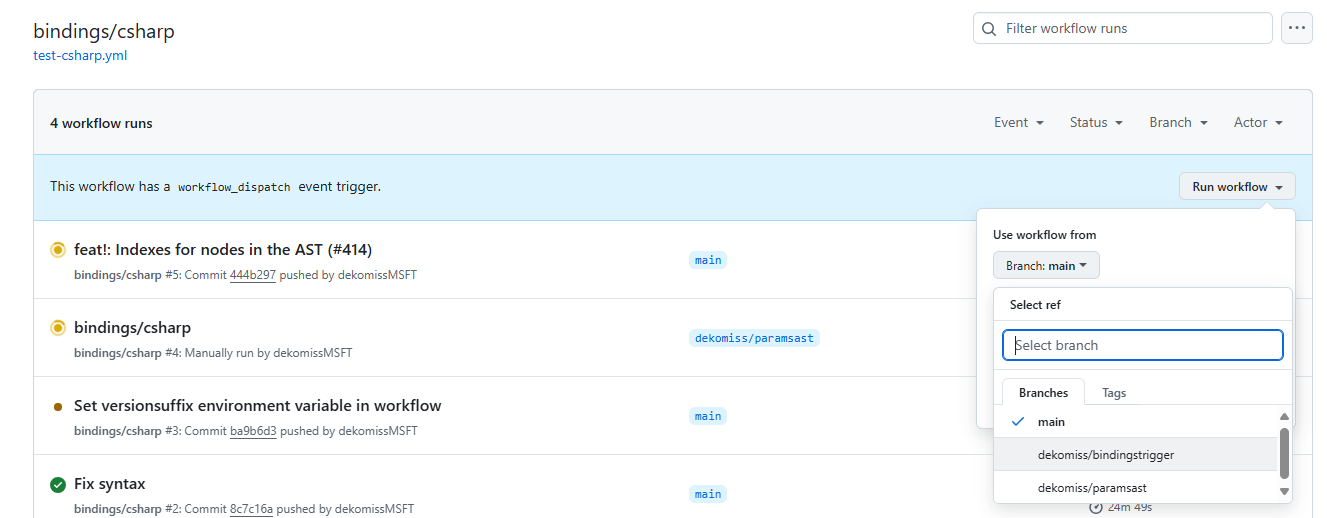

Once the workflow run completes, the generated Nuget can be downloaded by following these steps:
- Open the run.
- Click on
Build Regorus nugeton the left. - Expand the
Upload Regorus nugetstep. - Click the
Artifact download URLlink at the bottom. - Save and extract the downloaded zip file to find the
.nupkgfile.

Local
The cargo xtask runner provides helpers for local builds:
cargo xtask ffibuilds thebindings/fficrate for the host platform in debug mode. Add--target <triple>(repeatable) to cross-compile, or--releaseto produce optimised artefacts. Results land underbindings/ffi/target/<triple>/<profile>.cargo xtask nugetreuses those artefacts to pack the C# library. It defaults to debug builds for the host but accepts--target,--release,--artifacts-dir <path>to reuse existing binaries, and--enforce-artifactsto require every officially supported platform.cargo xtask test-csharpensures a NuGet is available (rebuilding when required or when--force-nugetis passed) and then runsRegorus.Tests,TestApp, andTargetExampleAppagainst it. The command accepts the same build flags ascargo xtask nuget.
Memory Usage Safeguards
The C# bindings expose allocator-backed memory tracking utilities via the static Regorus.MemoryLimits helper. Typical usage:
// Restrict total allocations to 128 MiB for the process
Regorus.MemoryLimits.SetGlobalMemoryLimit(128 * 1024 * 1024);

// Optional: tune how frequently each thread flushes its allocation counters
Regorus.MemoryLimits.SetThreadFlushThresholdOverride(256 * 1024);

// Engine operations throw InvalidOperationException with the allocator message if the budget is exceeded
using var engine = new Regorus.Engine();
var veryLargeJson = new string('x', 128 * 1024);
try
{
    engine.SetInputJson(veryLargeJson);
}
catch (InvalidOperationException ex)
{
    Console.WriteLine($"Allocator reported: {ex.Message}");
}

// Restore defaults once done
Regorus.MemoryLimits.SetGlobalMemoryLimit(null);
Regorus.MemoryLimits.SetThreadFlushThresholdOverride(null);
See bindings/csharp/Regorus.Tests/RegorusTests.cs for scenario coverage and bindings/csharp/TargetExampleApp/Program.cs for end-to-end usage.
RVM Usage Example
The RVM API lets you compile a program from modules/entrypoints and execute it in a VM:
using Regorus;

const string Policy = """
package demo
default allow = false
allow if {
  input.user == "alice"
  some role in data.roles[input.user]
  role == "admin"
}
""";

const string Data = """
{ "roles": { "alice": ["admin"] } }
""";

const string Input = """
{ "user": "alice" }
""";

var modules = new[] { new PolicyModule("demo.rego", Policy) };
var entryPoints = new[] { "data.demo.allow" };

using var program = Program.CompileFromModules(Data, modules, entryPoints);
var listing = program.GenerateListing();

using var vm = new Rvm();
vm.LoadProgram(program);
vm.SetDataJson(Data);
vm.SetInputJson(Input);

var result = vm.Execute();
Console.WriteLine($"allow: {result}");
Azure RBAC Condition Evaluation
Evaluate Azure RBAC condition expressions directly with a JSON evaluation context:
using Regorus;

const string Condition = "@Resource[owner] StringEquals 'alice'";
const string ContextJson = """
{
  "principal": {
    "id": "user-1",
    "principal_type": "User",
    "custom_security_attributes": {}
  },
  "resource": {
    "id": "/subscriptions/s1",
    "resource_type": "Microsoft.Storage/storageAccounts",
    "scope": "/subscriptions/s1",
    "attributes": {
      "owner": "alice",
      "confidential": true
    }
  },
  "request": {
    "action": "Microsoft.Storage/storageAccounts/read",
    "data_action": null,
    "attributes": {
      "clientIP": "10.0.0.1"
    }
  },
  "environment": {
    "is_private_link": null,
    "private_endpoint": null,
    "subnet": null,
    "utc_now": "2023-05-01T12:00:00Z"
  },
  "action": "Microsoft.Storage/storageAccounts/read",
  "suboperation": null
}
""";

var allowed = RbacEngine.EvaluateCondition(Condition, ContextJson);
Console.WriteLine($"RBAC condition allowed: {allowed}");