mirror of
https://github.com/microsoft/regorus.git
synced 2026-08-05 02:16:11 +00:00
 d561531613
This commit introduces a complete multi-threaded evaluation benchmark suite for both Rust and C# implementations of Regorus.

- Implemented engine evaluation benchmark with input and engine cloning strategies
- Implemented compiled policy evaluation benchmark with input cloning and shared compiled policy strategies.

- Created EngineEvaluationBenchmark.cs and CompiledPolicyEvaluationBenchmark.cs with time-based execution (3s warmup + 3s evaluation)
- Implemented configuration options matching Rust implementation (useClonedEngines, useSharedPolicies parameters)

- Created markdown analysis documentation with cross-platform performance analysis
- C# seems to achieve 58-89% of Rust performance on test machine.

Signed-off-by: Anand Krishnamoorthi <anakrish@microsoft.com>
Regorus CSharp
Regorus is
- Rego-Rus(t) - A fast, light-weight Rego interpreter written in Rust.
- Rigorous - A rigorous enforcer of well-defined Rego semantics.
See main Regorus page for more details about the project.
Building
Github Actions
The simplest way to build a Nuget for Regorus' C# bindings is to use Github Actions. The action to do so is named bindings/csharp and is defined in .github/workflows/test-csharp.yml.
There are two ways to trigger a Nuget build.
- Runs are triggered automatically whenever a push or pull request is made to the
mainbranch. - A run can be triggered manually by navigating to the action in the Github UI and clicking
Run workflow. This option allows you to generate a Nuget for any branch, which is useful when testing the integration of in-progress changes to Regorus with other projects. Nuget files that are generated via this flow will have amanualtriggersuffix appended to their version number, making it easy to distinguish them from Nugets generated using themainbranch.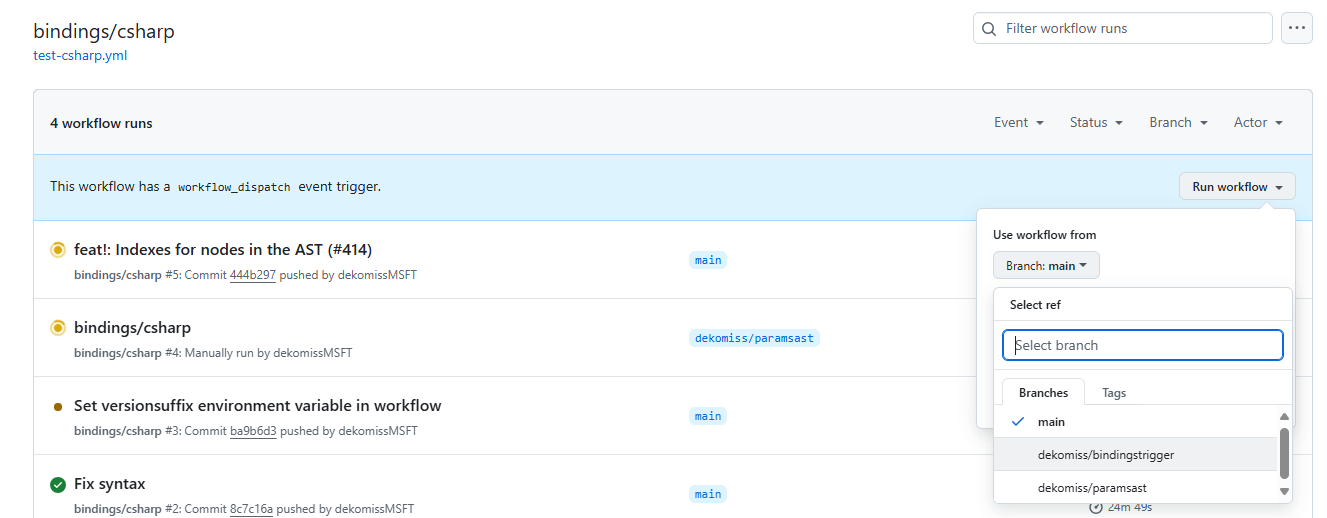

Once the workflow run completes, the generated Nuget can be downloaded by following these steps:
- Open the run.
- Click on
Build Regorus nugeton the left. - Expand the
Upload Regorus nugetstep. - Click the
Artifact download URLlink at the bottom. - Save and extract the downloaded zip file to find the
.nupkgfile.

Local
TODO