 Anand Krishnamoorthi
cc917ea75d
Anand Krishnamoorthi
cc917ea75d
* feat: Add Schema Registry and Validation Framework

This commit introduces a comprehensive schema registry and validation framework, providing schema-based validation of resources and policy effects.

- Thread-safe, in-memory registry for schema storage and management
- Global registry patterns for effects and resources
- Concurrent access with proper error handling
- Unicode schema names support

- JSON Schema-compliant validation for all primitive types
- Advanced constraint validation (patterns, ranges, length limits)
- Discriminated union support with anyOf schemas
- Detailed error reporting with nested validation paths
- Discriminated subobject validation for polymorphic schemas

- **Registry Tests**: All registry operations
- **Effect Tests**: Policy effect validation
- **Resource Tests**: Resource validation
- **Validation Tests**: Core validation engine
- Thread-safety, error handling, integration scenarios, edge cases

- **Dependencies**: dashmap, once_cell, regex
- **Thread Safety**: Minimal locking with Rc<Schema> sharing
- **Error Types**: TypeMismatch, OutOfRange, PatternMismatch, etc.

- Complete schema registry and validation subsystem
- Comprehensive test coverage
- Foundation for policy validation in Regorus

Benchmarks:

- Criterion benchmarks for basic types, effects and Azure resources
- Performance range: 3.22ns (string) to 34.74µs (Azure VM resource schema validation)
- String withs patterns validation: 30.2µs. Need to explore whether regex caching helps
  bring this down.
- Azure policy effects: 188ns-1.4µs

Signed-off-by: Anand Krishnamoorthi <anakrish@microsoft.com>

* feat: Complete target system with C# bindings and resource inference

- Add comprehensive target system with TargetRegistry and target-aware compilation
- Implement resource type inference from policy equality expressions
- Create modular C# bindings with separate wrapper classes for each concept
- Add thread-safe CompiledPolicy with reference counting for safe disposal
- Enhance FFI with detailed error propagation and target functionality
- Create TargetExampleApp demonstrating Azure Policy integration
- Add CI/CD pipeline testing for all C# applications
- Support target definitions with schema validation and resource selectors
- Implement PolicyModule struct and target-aware compilation methods
- Add comprehensive test coverage for target functionality

Signed-off-by: Anand Krishnamoorthi <anakrish@microsoft.com>

---------

Signed-off-by: Anand Krishnamoorthi <anakrish@microsoft.com>
Regorus
Regorus is
- Rego-Rus(t) - A fast, light-weight Rego interpreter written in Rust.
- Rigorous - A rigorous enforcer of well-defined Rego semantics.
Regorus is also
-
cross-platform - Written in platform-agnostic Rust.
-
no_std compatible - Regorus can be used in
no_stdenvironments too. Most of the builtins are supported. -
current - We strive to keep Regorus up to date with latest OPA release. Regorus defaults to
v1of the Rego language. -
compliant - Regorus is mostly compliant with the latest OPA release v1.2.0. See OPA Conformance for details. Note that while we behaviorally produce the same results, we don't yet support all the builtins.
-
extensible - Extend the Rego language by implementing custom stateful builtins in Rust. See add_extension. Support for extensibility using other languages coming soon.
-
polyglot - In addition to Rust, Regorus can be used from C, C++, C#, Golang, Java, Javascript, Python, and Ruby. This is made possible by the excellent FFI tools available in the Rust ecosystem. See bindings for information on how to use Regorus from different languages.
To try out a Javascript(WASM) compiled version of Regorus from your browser, visit Regorus Playground.
Regorus is available as a library that can be easily integrated into your Rust projects. Here is an example of evaluating a simple Rego policy:
fn main() -> anyhow::Result<()> {
    // Create an engine for evaluating Rego policies.
    let mut engine = regorus::Engine::new();

    let policy = String::from(
        r#"
       package example

       allow if {
          ## All actions are allowed for admins.
          input.principal == "admin"
       } else if {
          ## Check if action is allowed for given user.
          input.action in data.allowed_actions[input.principal]
       }
	"#,
    );

    // Add policy to the engine.
    engine.add_policy(String::from("policy.rego"), policy)?;

    // Add data to engine.
    engine.add_data(regorus::Value::from_json_str(
        r#"{
     "allowed_actions": {
        "user1" : ["read", "write"],
        "user2" : ["read"]
     }}"#,
    )?)?;

    // Set input and evaluate whether user1 can write.
    engine.set_input(regorus::Value::from_json_str(
        r#"{
      "principal": "user1",
      "action": "write"
    }"#,
    )?);

    let r = engine.eval_rule(String::from("data.example.allow"))?;
    assert_eq!(r, regorus::Value::from(true));

    // Set input and evaluate whether user2 can write.
    engine.set_input(regorus::Value::from_json_str(
        r#"{
      "principal": "user2",
      "action": "write"
    }"#,
    )?);

    let r = engine.eval_rule(String::from("data.example.allow"))?;
    assert_eq!(r, regorus::Value::Undefined);

    Ok(())
}
Regorus is designed with Confidential Computing in mind. In Confidential Computing environments, it is important to be able to control exactly what is being run. Regorus allows enabling and disabling various components using cargo features. By default all features are enabled.
The default build of regorus example program is 6.3M:
$ cargo build -r --example regorus; strip target/release/examples/regorus; ls -lh target/release/examples/regorus
-rwxr-xr-x  1 anand  staff   6.3M May 11 22:03 target/release/examples/regorus*
When all default features are disabled, the binary size drops down to 1.9M.
$ cargo build -r --example regorus --no-default-features; strip target/release/examples/regorus; ls -lh target/release/examples/regorus
-rwxr-xr-x  1 anand  staff   1.9M May 11 22:04 target/release/examples/regorus*
Regorus passes the OPA v1.2.0 test-suite barring a few builtins. See OPA Conformance below.
Bindings
Regorus can be used from a variety of languages:
- C: C binding is generated using cbindgen. corrosion-rs can be used to seamlessly use Regorous in your CMake based projects. See bindings/c.
- C freestanding: bindings/c_no_std shows how to use Regorus from C environments without a libc.
- C++: C++ binding is generated using cbindgen. corrosion-rs can be used to seamlessly use Regorous in your CMake based projects. See bindings/cpp.
- C#: C# binding is generated using csbindgen. See bindings/csharp for an example of how to build and use Regorus in your C# projects.
- Golang: The C bindings are exposed to Golang via CGo. See bindings/go for an example of how to build and use Regorus in your Go projects.
- Python: Python bindings are generated using pyo3. Wheels are created using maturin. See bindings/python.
- Java: Java bindings are developed using jni-rs. See bindings/java.
- Javascript: Regorus is compiled to WASM using wasmpack. See bindings/wasm for an example of using Regorus from nodejs. To try out a Javascript(WASM) compiled version of Regorus from your browser, visit Regorus Playground.
- Ruby: Ruby bindings are developed using magnus. See bindings/ruby.
To avoid operational overhead, we currently don't publish these bindings to various repositories. It is straight-forward to build these bindings yourself.
Getting Started
examples/regorus is an example program that shows how to integrate Regorus into your project and evaluate Rego policies.
To build and install it, do
$ cargo install --example regorus --path .
Check that the regorus example program is working
$ regorus
Usage: regorus <COMMAND>

Commands:
  ast    Parse a Rego policy and dump AST
  eval   Evaluate a Rego Query
  lex    Tokenize a Rego policy
  parse  Parse a Rego policy
  help   Print this message or the help of the given subcommand(s)

Options:
  -h, --help     Print help
  -V, --version  Print version
First, let's evaluate a simple Rego expression 1*2+3
$ regorus eval "1*2+3"
This produces the following output
{
  "result": [
    {
      "expressions": [
        {
           "value": 5,
           "text": "1*2+3",
           "location": {
              "row": 1,
              "col": 1
            }
        }
      ]
    }
  ]
}
Next, evaluate a sample policy and input (borrowed from Rego tutorial):
$ regorus eval -d examples/server/allowed_server.rego -i examples/server/input.json data.example
Finally, evaluate real-world policies used in Azure Container Instances (ACI)
$ regorus eval -b tests/aci -d tests/aci/data.json -i tests/aci/input.json data.policy.mount_overlay=x
Policy coverage
Regorus allows determining which lines of a policy have been executed using the coverage feature (enabled by default).
We can try it out using the regorus example program by passing in the --coverage flag.
$ regorus eval -d examples/server/allowed_server.rego -i examples/server/input.json data.example --coverage
It produces the following coverage report which shows that all lines are executed except the line that sets allow to true.
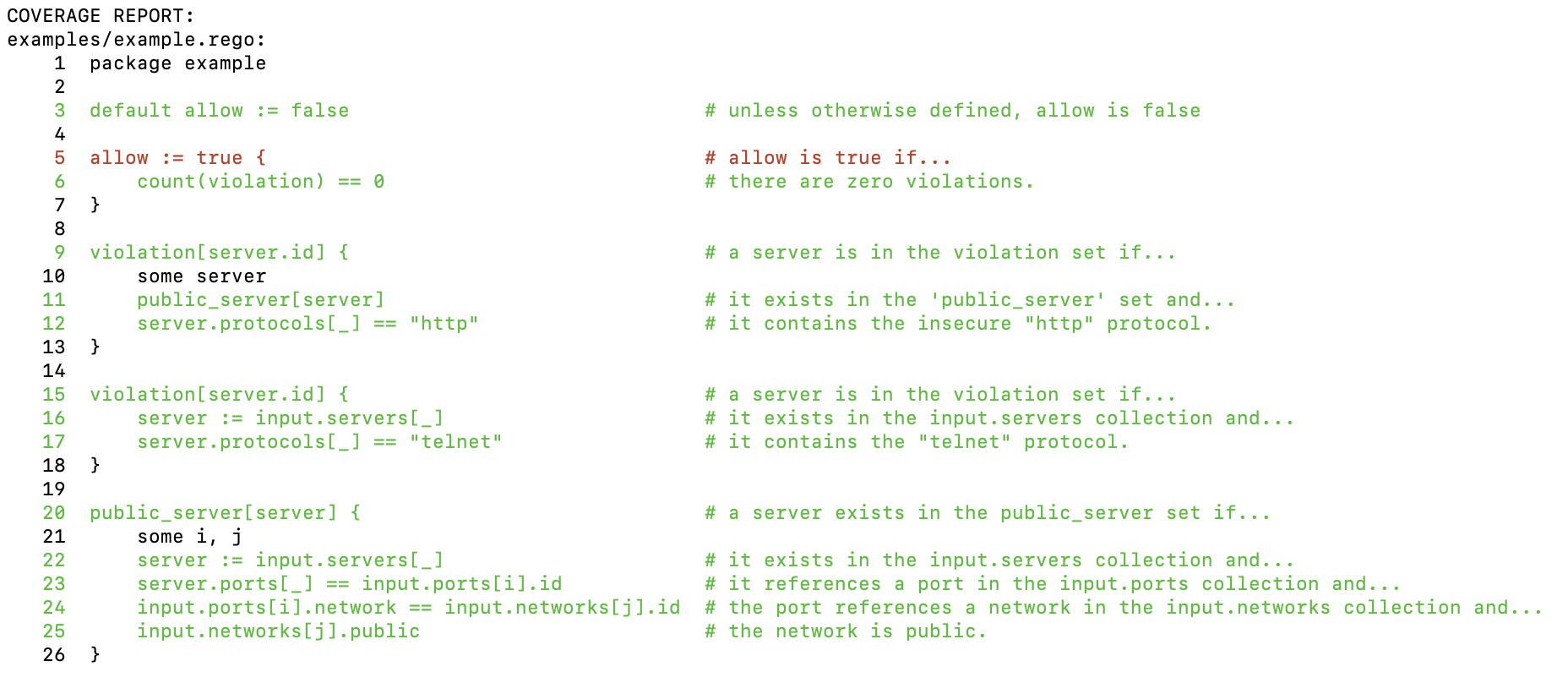
See Engine::get_coverage_report for details. Policy coverage information is useful for debugging your policy as well as to write tests for your policy so that all lines of the policy are exercised by the tests.
ACI Policies
Regorus successfully passes the ACI policy test-suite. It is fast and can run each of the tests in a few milliseconds.
$ cargo test -r --test aci
    Finished release [optimized + debuginfo] target(s) in 0.05s
    Running tests/aci/main.rs (target/release/deps/aci-2cd8d21a893a2450)
aci/mount_device                                  passed    3.863292ms
aci/mount_overlay                                 passed    3.6905ms
aci/scratch_mount                                 passed    3.643041ms
aci/create_container                              passed    5.046333ms
aci/shutdown_container                            passed    3.632ms
aci/scratch_unmount                               passed    3.631333ms
aci/unmount_overlay                               passed    3.609916ms
aci/unmount_device                                passed    3.626875ms
aci/load_fragment                                 passed    4.045167ms
Run the ACI policies in the tests/aci directory, using data tests/aci/data.json and input tests/aci/input.json:
$ regorus eval -b tests/aci -d tests/aci/data.json -i tests/aci/input.json data.policy.mount_overlay=x
Verify that OPA produces the same output
$ diff <(regorus eval -b tests/aci -d tests/aci/data.json -i tests/aci/input.json data.framework.mount_overlay=x) \
       <(opa eval -b tests/aci -d tests/aci/data.json -i tests/aci/input.json data.framework.mount_overlay=x)
Performance
To check how fast Regorus runs on your system, first install a tool like hyperfine.
$ cargo install hyperfine
Then benchmark evaluation of the ACI policies,
$ hyperfine "regorus eval -b tests/aci -d tests/aci/data.json -i   tests/aci/input.json data.framework.mount_overlay=x"
Benchmark 1: regorus eval -b tests/aci -d tests/aci/data.json -i tests/aci/input.json data.framework.mount_overlay=x
  Time (mean ± σ):       4.6 ms ±   0.2 ms    [User: 4.1 ms, System: 0.4 ms]
  Range (min … max):     4.4 ms …   6.0 ms    422 runs
Compare it with OPA
$ hyperfine "opa eval -b tests/aci -d tests/aci/data.json -i tests/aci/input.json data.framework.mount_overlay=x"
Benchmark 1: opa eval -b tests/aci -d tests/aci/data.json -i tests/aci/input.json data.framework.mount_overlay=x
  Time (mean ± σ):      45.2 ms ±   0.6 ms    [User: 68.8 ms, System: 5.1 ms]
  Range (min … max):    43.8 ms …  46.7 ms    62 runs
OPA Conformance
Regorus has been verified to be compliant with OPA v1.2.0 using a test driver that loads and runs the OPA testsuite using Regorus, and verifies that expected outputs are produced.
The test driver can be invoked by running:
$ cargo test -r --test opa --features opa-testutil,serde_json/arbitrary_precision
Currently, Regorus passes all the non-builtin specific tests. See passing tests suites.
The following test suites don't pass fully due to missing builtins:
globsmatchgraphqlinvalidkeyerrorjsonpatchjwtbuiltinsjwtdecodeverifyjwtencodesignjwtencodesignheadererrorsjwtencodesignpayloaderrorsjwtencodesignrawjwtverifyhs256jwtverifyhs384jwtverifyhs512jwtverifyrsanetcidrcontainsnetcidrcontainsmatchesnetcidrexpandnetcidrintersectsnetcidrisvalidnetcidrmergenetcidroverlapnetlookupipaddrproviders-awsregometadatachainregometadataruleregoparsemodulerendertemplate
They are captured in the following github issues.
Cryptographic builtins are not supported by design. Users that need cryptographic builtins are encouraged to use extensions.
Grammar
The grammar used by Regorus to parse Rego policies is described in grammar.md in both W3C EBNF and RailRoad Diagram formats.
Contributing
This project welcomes contributions and suggestions. Most contributions require you to agree to a Contributor License Agreement (CLA) declaring that you have the right to, and actually do, grant us the rights to use your contribution. For details, visit https://cla.opensource.microsoft.com.
When you submit a pull request, a CLA bot will automatically determine whether you need to provide a CLA and decorate the PR appropriately (e.g., status check, comment). Simply follow the instructions provided by the bot. You will only need to do this once across all repos using our CLA.
This project has adopted the Microsoft Open Source Code of Conduct. For more information see the Code of Conduct FAQ or contact opencode@microsoft.com with any additional questions or comments.
Trademarks
This project may contain trademarks or logos for projects, products, or services. Authorized use of Microsoft trademarks or logos is subject to and must follow Microsoft's Trademark & Brand Guidelines. Use of Microsoft trademarks or logos in modified versions of this project must not cause confusion or imply Microsoft sponsorship. Any use of third-party trademarks or logos are subject to those third-party's policies.