mirror of
https://github.com/microsoft/regorus.git
synced 2026-08-05 02:16:11 +00:00
 cc917ea75d
* feat: Add Schema Registry and Validation Framework

This commit introduces a comprehensive schema registry and validation framework, providing schema-based validation of resources and policy effects.

- Thread-safe, in-memory registry for schema storage and management
- Global registry patterns for effects and resources
- Concurrent access with proper error handling
- Unicode schema names support

- JSON Schema-compliant validation for all primitive types
- Advanced constraint validation (patterns, ranges, length limits)
- Discriminated union support with anyOf schemas
- Detailed error reporting with nested validation paths
- Discriminated subobject validation for polymorphic schemas

- **Registry Tests**: All registry operations
- **Effect Tests**: Policy effect validation
- **Resource Tests**: Resource validation
- **Validation Tests**: Core validation engine
- Thread-safety, error handling, integration scenarios, edge cases

- **Dependencies**: dashmap, once_cell, regex
- **Thread Safety**: Minimal locking with Rc<Schema> sharing
- **Error Types**: TypeMismatch, OutOfRange, PatternMismatch, etc.

- Complete schema registry and validation subsystem
- Comprehensive test coverage
- Foundation for policy validation in Regorus

Benchmarks:

- Criterion benchmarks for basic types, effects and Azure resources
- Performance range: 3.22ns (string) to 34.74µs (Azure VM resource schema validation)
- String withs patterns validation: 30.2µs. Need to explore whether regex caching helps
  bring this down.
- Azure policy effects: 188ns-1.4µs

Signed-off-by: Anand Krishnamoorthi <anakrish@microsoft.com>

* feat: Complete target system with C# bindings and resource inference

- Add comprehensive target system with TargetRegistry and target-aware compilation
- Implement resource type inference from policy equality expressions
- Create modular C# bindings with separate wrapper classes for each concept
- Add thread-safe CompiledPolicy with reference counting for safe disposal
- Enhance FFI with detailed error propagation and target functionality
- Create TargetExampleApp demonstrating Azure Policy integration
- Add CI/CD pipeline testing for all C# applications
- Support target definitions with schema validation and resource selectors
- Implement PolicyModule struct and target-aware compilation methods
- Add comprehensive test coverage for target functionality

Signed-off-by: Anand Krishnamoorthi <anakrish@microsoft.com>

---------

Signed-off-by: Anand Krishnamoorthi <anakrish@microsoft.com>
Regorus CSharp
Regorus is
- Rego-Rus(t) - A fast, light-weight Rego interpreter written in Rust.
- Rigorous - A rigorous enforcer of well-defined Rego semantics.
See main Regorus page for more details about the project.
Building
Github Actions
The simplest way to build a Nuget for Regorus' C# bindings is to use Github Actions. The action to do so is named bindings/csharp and is defined in .github/workflows/test-csharp.yml.
There are two ways to trigger a Nuget build.
- Runs are triggered automatically whenever a push or pull request is made to the
mainbranch. - A run can be triggered manually by navigating to the action in the Github UI and clicking
Run workflow. This option allows you to generate a Nuget for any branch, which is useful when testing the integration of in-progress changes to Regorus with other projects. Nuget files that are generated via this flow will have amanualtriggersuffix appended to their version number, making it easy to distinguish them from Nugets generated using themainbranch.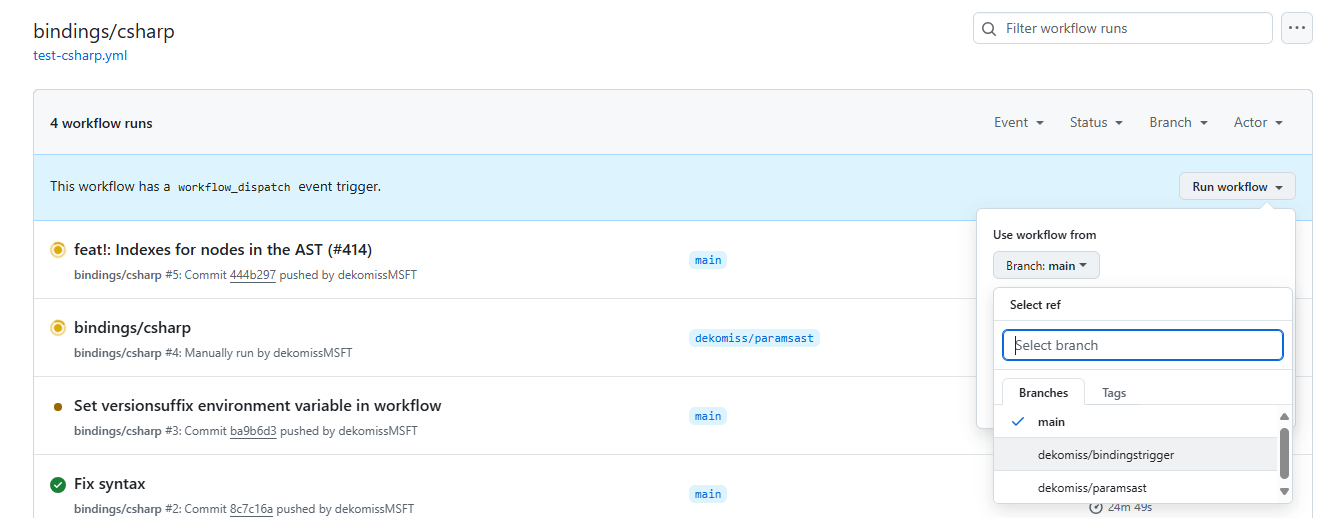

Once the workflow run completes, the generated Nuget can be downloaded by following these steps:
- Open the run.
- Click on
Build Regorus nugeton the left. - Expand the
Upload Regorus nugetstep. - Click the
Artifact download URLlink at the bottom. - Save and extract the downloaded zip file to find the
.nupkgfile.

Local
TODO